

Trump allows the global economy to "suffocate"
The deliberate "inaction" of the US Navy regarding the reopening of the Straits of Hormuz is raising pointed questions among geopolitical analysts. Is this a strategic trap set by Donald Trump to upend the global supply chain, turning energy into a weapon of mass destruction? In any case, with oil galloping toward the $300 mark, Europe and China are being driven toward economic asphyxiation, while the White House manages to redistribute global power through the ensuing chaos.
Narrow passage
The Strait of Hormuz is twenty-one miles wide, with two navigable shipping lanes, each two miles wide, separated by a two-mile buffer zone. There is no alternative. Between Saudi Arabia’s East-West pipeline to Yanbu and the United Arab Emirates' pipeline to the port of Fujairah, perhaps only five million barrels in total can bypass the waterway. The math simply does not add up. The strait is not "narrow" just politically; it is so geologically and hydrographically.
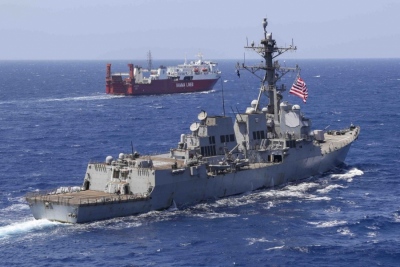
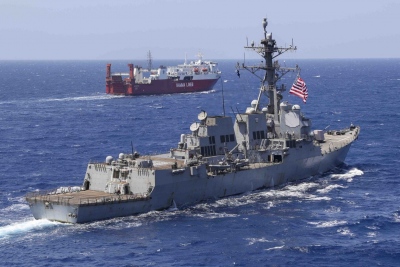
Many analysts speak of minesweepers and specialized warfare units. However, they are misreading the situation. The primary constraint at Hormuz has never been mines or security. It is the willingness and capability of the US Navy to reopen it. While the White House and the US Navy are supposedly working hard to clear the passage, progress remains suspiciously slow.
Meanwhile, a new post on Truth Social by US President Donald Trump suggests we might need to consider a different hypothesis. "I wonder what happens if we 'finish off' what is left of the Iranian State and leave the countries that use the so-called Strait responsible for it?" President Trump wrote. "That will mobilize some of our reluctant 'Allies,' and fast!" As you can see, this leads to a critical question: does the White House have any intention of reopening the Strait of Hormuz at all?
Let's unpack this..
— John Ʌ Konrad V (@johnkonrad) March 18, 2026
What if the White House has no intention of reopening the Strait of Hormuz?
What if this war is really about ships & tariffs?
I had a long discussion with senior DOE official yesterday on background. I can’t share any details but it’s clear everyone’s… https://t.co/DCP0uw7C4E
The insurance switch
When the seven P&I clubs belonging to the International Group issued 72-hour cancellation notices due to the war on March 5, they didn't just increase costs; they made transit impossible. P&I clubs insure approximately 90% of the global maritime fleet. Without their coverage, ships cannot sail. Port authorities will not allow them to dock, banks will not finance the cargo, and charterers will not book the vessel.
The entire system, from the loading dock to the discharge terminal, relies on a chain of contracts starting with a club in London, Oslo, or Tokyo. When coverage was withdrawn, the supply chain broke—not just for a few ships, but for the global fleet. War risk premiums jumped from 0.25% to 1% of the ship's value, renewing every seven days. VLCC charter rates quadrupled to nearly $800,000 per day. More than 1,000 ships are currently trapped in the Persian Gulf, racking up charter costs with nowhere to go. By March 3, only four ships had crossed the Strait, down from a daily average of 77.
Then Trump did something almost no one understood. He ordered the U.S. International Development Finance Corporation (DFC) to create a $20 billion maritime reinsurance facility, with Chubb as the lead insurer, making the US government the insurer of last resort for Gulf shipping. A sovereign state positioned itself as the "backstop" for war risk insurance at the world's most critical maritime chokepoint.
The DFC facility, in coordination with US Central Command and the Treasury, offers hull, machinery, and cargo coverage on a rolling basis to eligible vessels. The United States now controls the on/off switch for the Strait of Hormuz—not through naval force, but through insurance. Read the latest MARAD directive carefully: US-flagged, owned, or crewed merchant vessels must maintain a minimum distance of 30 nautical miles from US warships. And re-read the DFC announcement: "in coordination with US Central Command." They cannot pass without the Navy's permission, and the green light has not appeared.
The leverage hypothesis
Now connect the dots. "Attack Iran, and Europe either retreats or sinks into an energy crisis." The European shipping community and political establishment spent the last year ignoring, undermining, and laughing at every maritime initiative proposed by Trump. They criticized USTR tariffs, mocked the SHIPS Act, and blocked IMO exemptions.
Now, their energy reserves must pass through an insurance facility controlled by Washington. "Let their naval forces solve it," one might say—except everyone knows they cannot. European naval forces are too small, too slow, and too poorly equipped for escort operations in narrow passages like Hormuz. All European fleets combined could not send more than three ships at a time to the Red Sea.
Ultimately, Europe will have to yield to ensure the US Navy and US insurance protection fully reopen the Strait. What will this "yield" involve? The IMO carbon tax, Greenland, tariff concessions, and the SHIPS Act. Every maritime policy priority that Europe and China blocked over the past year is back on the table. It is now clear that the conventional analysis of the Strait of Hormuz provided by mainstream media is incorrect. The administration is not thinking about it the way they think they are.
The Earnest Will precedent
There is a historical precedent that reinforces this hypothesis. The last time the US Navy escorted tankers through Hormuz was Operation Earnest Will during the Tanker War of 1987-88. Foreign tankers seeking protection had to be re-flagged under the US flag. Kuwaiti supertankers raised the American flag to enjoy US escort.
Trump has already stated that the Navy will escort ships through Hormuz "if necessary." If the same requirement applies, every European and Asian tanker wanting a US escort will have to fly the American flag. Consider what this means for the SHIPS Act, the Jones Act, and the US fleet. Hormuz becomes a catalyst for Trump's agenda. What he could not achieve through legislation or diplomacy, the American President will achieve through the war in Iran.
Meanwhile, Iran is selectively allowing ships to pass. Turkish, Indian, Chinese, and some Saudi tankers are transiting through Iranian territorial waters. About eighteen tankers, mostly Chinese, have managed it according to Lloyd’s. Western ships are excluded. This "closure" is a sorting mechanism. Iran decides who trades and who does not—unless the US Navy opens it for everyone under American terms. This is the decision the world must make: either let Iran set its own tolls or give the green light to Trump’s plans for global Shipping.
The analysis
But what about the home front? Analysts are certain this attack cost the Republicans the midterm elections and possibly the next presidential election. Perhaps. But maybe there is an alternative Hormuz hypothesis. While television oil analysts focus on global markets, the real experts in Houston are watching something else: the fracture of the global energy market.
The real threat is not $200 oil; it is the breakdown of the system. We will have cheap energy in exporting countries and catastrophic energy costs in regions far from reserves. A barrel in the Persian Gulf will cost $2, a barrel in the American Gulf $20, and a barrel in the United Kingdom $2,000.
What have I been saying for three weeks?! (Yes three)
— John Ʌ Konrad V (@johnkonrad) March 17, 2026
IDC what the price of oil climbs to, as long as it remains global.
The real danger is it starts to fracture between nations and regions. https://t.co/XRWU6dG3e9
Global prices only work if there is a surplus of tankers. Before the attacks on Iran, that surplus was minimal. Now, with supertankers stuck in the Gulf, it has vanished. The price of Brent is currently $106, while WTI remains below $100. In the domestic market, diesel is stabilizing and natural gas prices are falling as LNG intended for export stays home.
Trump issued a 60-day Jones Act waiver and opened Venezuelan oil sales to US companies via a new Treasury license for PDVSA. These are exactly the measures you take if you are trying to lower prices in the US while the global market fractures. Tankers charge per day, so long-distance routes become relatively more expensive. Venezuelan crude on short routes to the Gulf becomes much cheaper for American refineries than Middle Eastern crude traveling around the Cape of Good Hope for European or Asian buyers.
Look at who benefits. The three most powerful industries in the US are tech, Wall Street, and energy. Tech gets cheaper LNG for data centers. Wall Street exploits uncertainty and panic for trading profits. Energy companies just gained access to Venezuela and the Gulf.
Meanwhile, California is closing refineries and blocking pipelines, forcing gasoline imports from South Korea on ships with skyrocketing daily rates. Governor Newsom, the leading candidate for President in 2028, is frustrated. New England is importing LNG and diesel by ship. If Hormuz remains closed, prices will skyrocket in those states. Costs in "red" states are decreasing, while costs in "blue" states are increasing. Europe will yield on the major policy issues it disagreed on until the midterms.
"The only thing that will truly stabilize global oil markets and, by extension, gas prices for American drivers is the reopening of the Strait of Hormuz," Newsom wrote in a statement last week. "But Trump has no plan to make that happen. The US cannot drill its way out of a crisis the President himself created." In any case, time will tell. However, the logic is clear, and the White House sees it.
www.bankingnews.gr







Σχόλια αναγνωστών